Sunday, 12 April 2009

SELF DIRECTING FIELD STUDY VISIT

REGENTS.CANAL.

Our second field study visit of the year was self directed and we were asked to visit a site or number of sites along the waterways and in particular canals.I decided to stay close to home and firstly decided to walk Regents canal from Limehouse Basin to Kings Cross to get an insight into the users of a modern day urban canal system.


DEPTFORD.CREEK.

The next visit took me to Deptford Creek. One of London's most historic waterways and home to a number of fresh and salt water plants and animals. it sounds like a hidden gem in the heart of London. Upon arrival at the Creek Centre, which was home to a host of weird and wonderful objects claimed to have been found in the canal, we were confronted by a bohemium looking chap who was very interested in who we were. When we told him we were Landscape Architecture students at Kingston University (usually a free pass to anywhere) he called us "landscrapers" and told us we had to leave. Oh well. The creek did actually look very interesting and it was a shame we couldn't get down there but another interesting waterway nevertheless.


CREMORNE.RIVERSIDE.CENTRE
.

The next visit was to Cremorne Riverside Centre, a bit of a wild card, located on the thames not far from Chelsea. I came accross this while researching for places to go and noticed this on a website called waterscape.com which was showcasing the finalists for the 2009 waterways renaissance awards. The centre was designed by Sarah Wrigglesworth architects and houses boating facilities for young people. I found this site interested for its cladding which is done in Cor-ten steel which is low maintenance and vandal proof. It work wel for the site as it represents the rusting hull of an old ship.


SUTCLIFFE.PARK
.

Located in grenwich and re-landscaped in 2003 to replace the un-used playing fields. The park is now a flood alleviation and wetland site. Although not a great looking site it works well and is now home to a varity of wildflowers due to the moist earth. This site has given me some inspiration for the Wey & Arun project.


Monday, 19 January 2009

WIDEX HEARING GARDEN


A garden designed around sound. The award winning garden from Widex participated in the Hampton Court Palace Flower Show.

Thursday, 8 January 2009

PRIORITIES


This is the time of year when I need to start thinking about the next stage of my life as I am fast approaching the end of my BA in Landscape Architecture and need to start thinking about a job for my year out.

At this moment in time I would be happy working for
a large practice undertaking worldwide projects or a small practice working on local schemes as long as the company had similar aspirations to me. My design work is normally clean, crisp and simple. I try to challenge traditional methods of design while being considerate to the environment. I also have a keen interest in material qualities a
nd attention to detail is essential.

Ideally i would love to work for a multi-disciplined company, working with master planners, architects etc as well as landscape architects and also working in both the public and private sectors. This would be the best way to broaden my
knowledge of design and planning.

Two practices in London that i aspire to be part of are Gross.Max and Scape Design Associates. both createoutstanding work worldwide to an exceptional standard. Gross.Max in particular are one of my favourites, its not just the final outcome that i admir
e with them, but the actual design process: the models, the sketches, the photoshop work is just awe inspiring to me so they would definitely be a practice I aspire to be part of.

Artcicle on Gross.Max:
http://www.eca.ac.uk/staff_profiles/view/eelco-hooftman/518/breeze-of-air-hortus-conclusus/

Three images above by Gross.Max


I have also been considering working abroad and a practice I particularly like are Peter Walker and Partners (PWP) a world renowned firm based in Berkeley, California with work ranging from planning to detailed design.
PWP

Articles about PWP:
http://www.felixsalmon.com/000236.html,

Monday, 15 December 2008

TYPOGRAPHY

I've always been a big fan of typography and always take careful consideration when selecting fonts, sizes and colours. I was experimenting with type during my last project and came up with this 3D grass type which I created in photoshop. 

TANNERY BASIN.

Some of my work from the last studio project. After visiting the sight and speaking to a number of people involved with the restoration of the Wey and Arun Canal we were asked to come up with proposals for a small section of the proposed extension of the canal near Shadwell, off Tannery Lane Bridge. The substantial site is currently a scrubland home to a a large number of invasive species such as Urtica Dioica.
I found this project very challenging, firstly because i have never really worked on a rural project, secondly because I felt that the clients demands were unrealistic thus making it very hard to tackle the project.Time played an important role and i wanted to create an inviting public open space that changes over time. It also needed to be considerate to the local residents and an peaceful yet productive open space.


Wednesday, 10 December 2008

[PLASTICITY] - Science Museum.

To get some inspiration for our new studio project i decided to go to the Science Museum and found this interesting exhibition looking at the history of plastics and the huge impact they have had on our lives. The exhibit started looking at Leo Baekeland and his Bakelite products which were the first man made material in 1907. 

I looked at the widespread uses of plastics and the properties and uses of the key
 plastics including polythene, polyurethene, polyester, nylon and acrylic.

The exhibit went on to look at how plastics are used today and the environmenta
l implications of their use. The final section looked at the future showing cutting edge proto-types,such as plastics used in sportswear, and how plastics can be used in a more sustainable way 

There was some really interesting matter here such as this strange rubbery object below that, when you got near to it, pulsated and wobbled as if it were alive. This movable rubber form gave me inspiration for my PLAY project. 
Thursday, 20 November 2008

SEIZURE-151-189 Harper Road, London, SE1.


As landscape architecture often deals with the public sector and in particular social housing I thought it would be interesting to see how British artist Roger Hiorns created an unexpected sculptural form within an abandoned housing estate in Elephant & Castle due for demolition.

Hiorns has always been interested in making use of unlikely materials such as engines, detergent, disinfectant, steel poles and in this case copper sulphate.

Seizure was created by first making structural alterations to flat 159 to turn it into a completely watertight tank reinforced on the outside but leaving the ceiling accessible by puncturing holes to the flat above. Now that the flat was prepared for its transformation the copper sulphate needed to be prepared. hundreds of bags of the chemical was mixed, on site, with very hot water in large steel tanks. More than 70,000 litres of the solution was now ready to be pumped into 159. An initial temperature of 60 degrees centigrade was needed for the chemical reaction to take place. Nearly three weeks later the temperature had dropped to around 30 degrees and the crystallisation was complete. The liquid was drained and the crystalised caves had been achieved.


The results were impressive and surreal at the same time. On arrival we were told to put on wellies and gloves and at this point was intrigued as to what I was about to witness. A mass of blue crystals flickering white from the sun through the doorway. It was unbelievable how such an extreme transformation could be created from a chemical reaction it was like walking into an someones house that had been infected or mutated by some alien species . Seeing the bathtub and light fittings covered in these crystals was the most interesting and it was a shame that all household items hadn't been left in flat 159, such as a sofa and bed, as seeing everyday objects in this way would have been really interesting. 

Monday, 17 November 2008

KEW.GARDENS.

Went to Kew gardens the other day with Uni for a talk with David Barnes the manager of Horticulture at Kew. The talk was about the managment of such a large site and in particular looking at how the compost used on site is created. an extremely interesting talk and got lots of information for my extended essay. I managed to get two twenty minute recording of this talk, so, when I work out how to upload audio to bogger I wil post them up so watch this space.

Another interesting thing taken from the visit was the Xstrata treetop walk designed by, opened in May 2008 and designed by Marks Barfield Architects.
check t out........www.markbarfield.com


Friday, 3 October 2008

The Canal Museum, London.


In preparation for our trip to along the Wey and Arun canal I thought it might be an idea to get a bit of an insight into canal life and find out some information about the history of canals. 


The museum in housed in an old ice warehouse built in the 18th century for Carlo Gatti,the famous ice cream maker, to store ice imported from Norway.

The museum includes a real narrowboat cabin, a history of London's inland waterways, the cargoes carried and the people who lived and worked on canals.

The actual museum was a bit dull and dated it did provide some interesting information and being able to peer down into the huge ice wells used to store the huge quantities of ice was the highlight for me.

Sunday, 10 August 2008

LANDSCAPE INSTITUTE

At the end of my second year at Kingston university we displayed our work for the Waterloo project in the Waterloo gallery. Our work was featured in the Landscape Institutes publication 08.08. Here is some photos of the article featuring some of my work

Sunday, 11 May 2008

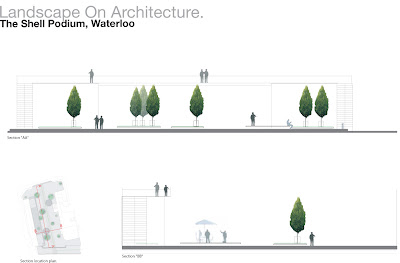
The.Shell.Podium.Waterloo


My final project in second year was based in Waterloo. I chose a site on the South Bank near the London Eye and Jubilee Gardens. The Shell Podium is an area of public open space that has a high turnover of visitors due to it being a gateway to the two above attractions but has a sixties concrete feel. Here are is some of my work showing my proposal for the site

College.Roundabout.


Here is some of my work from the beginning of the year. This is my proposal for an installation on the college Roundabout in Kingston-Upon-Thames.

Spraying.

The.Cans.Festival > stencil art 3rd 4th 5th May 2008


Went to this stencil art street exhibition on bank holiday monday and it was busy! It had previously been advertised on BBC news and as soon as people hear the name Banksy or Banksky as most people like to refer to him they jump at the chance of a free day out. I was interested in the art itself which is a nice change from the stereotypical graffiti that is seen around just about every corner of London. This had much more meaning, style and clever uses of everyday images rather than just the bragging right of tagging the local kebab shop.


The main reason I was interested in seeing this spectacle was the street itself. My final studio project at uni was based in and around the Waterloo area and have spent many an afternoon wandering the darkest, dirtiest tributaries of Lower Marsh and York Rd. i had come to know Waterloo "like the back of my hand", a statement Bridget Snaith had once told me but never quite believed up until now.

So, Leake Street was its name and its an unusual place to say the least, a service road is its main purpose but located randomly located along it are steel doors that occasionally swing open to reveal a suited smoker, or not. Its other purpose is a haven for rough sleepers who can be seen at almost any time of the day. Oh, and sometimes can be used as advertising space, see below..


The thing I found interesting about this event was how a pretty dull, sometimes scary place to be had attracted almost 30,000 people in 3 days. it was an impressive statistic, I cant imagine that many people walking along there in a year.
to sum up I though it was an interesting day out with a lot of stuff to see not just stencil art and i think the use of this underused public road was a perfect location. I just hope that a lot of the stuff from the 3 days is left on the walls and not destroyed.